If you are interested in movies, web series, animation, gaming, or creative design, a career in visual effects (VFX) can be an exciting option. Today, VFX is used in almost every type of entertainment content, from big-budget films to advertisements and social media videos.
For students and beginners looking to enter this field, choosing the right VFX Course in Delhi can be a good first step. Delhi has several training institutes where students can learn industry-related software, creative techniques, and practical VFX skills.
But before joining a course, it is important to understand what VFX actually involves, what you will learn, which career options are available, and how to choose the right institute.
VFX Course in Delhi
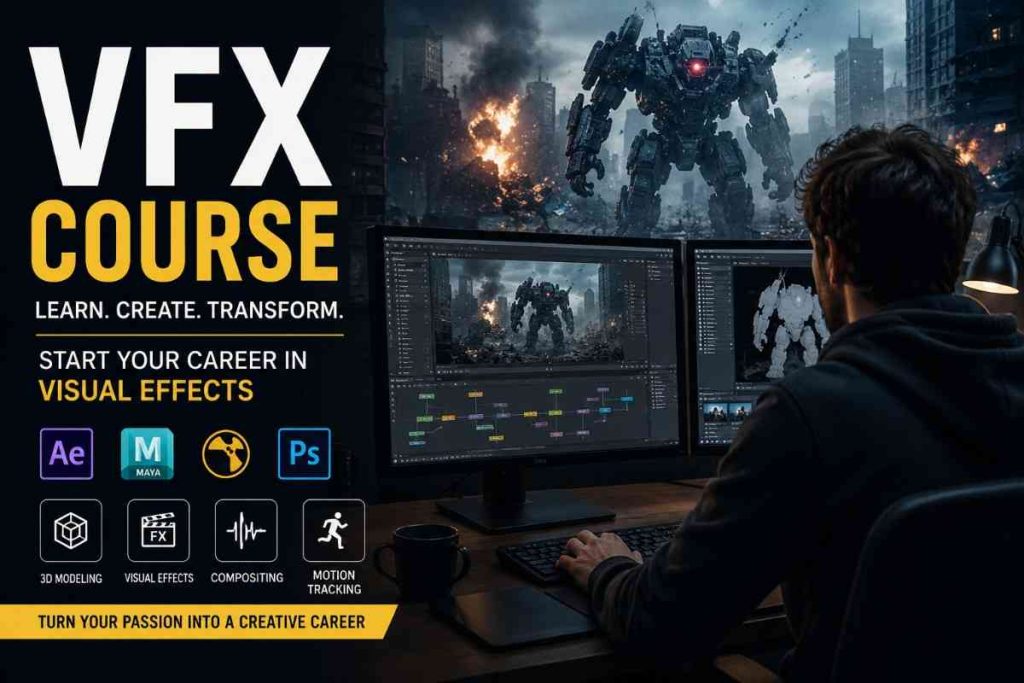
What Is VFX?
VFX stands for Visual Effects. It is the process of creating or modifying visual elements that cannot easily be captured during normal filming.
For example, imagine a movie scene showing a huge explosion, a fantasy world, a flying superhero, or a city that does not actually exist. Many of these elements can be created or enhanced using VFX.
VFX artists combine computer-generated elements with real footage to create believable scenes.
Some common examples of VFX include:
- Green screen replacement
- 3D modelling
- Character animation
- Motion tracking
- Compositing
- Rotoscoping
- Special effects
- Environment creation
- CGI
Because of these applications, VFX has become an important part of modern filmmaking and digital entertainment.
Why Choose a VFX Career?
One of the biggest advantages of VFX is the variety of career opportunities available. You do not necessarily have to work only in films.
VFX professionals can work in:
- Movies
- Web series
- Television
- Advertising
- Gaming
- Animation
- Music videos
- YouTube content
- Virtual production
- Post-production studios
Another advantage is that VFX combines technology and creativity. If you enjoy working with computers but also like creating visual ideas, this field can be a suitable career choice.
The industry also allows professionals to specialize in a particular area rather than learning everything at once.
Why Consider a VFX Course in Delhi?
Delhi and the National Capital Region have a large education and media ecosystem. Students can find different types of creative and technical training programs in the region.
A good VFX Course in Delhi can introduce beginners to the basic concepts of visual effects and gradually move toward advanced projects.
Instead of trying to learn everything randomly from online videos, a structured course can provide a proper learning path.
A classroom or guided training environment can also make it easier to ask questions, complete assignments, and receive feedback on your work.
However, the institute you choose matters. Students should compare the syllabus, practical training, faculty experience, software training, projects, and overall course structure before enrolling.
What Will You Learn in a VFX Course?
The exact syllabus depends on the institute, but a professional course generally covers several important areas.
1. Compositing
Compositing is one of the most important VFX skills. It involves combining different visual elements into one final scene.
For example, a person may be filmed in front of a green screen. The green background can then be removed and replaced with another environment.
2. Rotoscoping
Rotoscoping involves separating objects or people from the background. It is often used when green-screen footage is not available or when precise object isolation is required.
3. Motion Tracking
Motion tracking helps artists follow the movement of an object or camera in a video.
This technique is useful when adding digital elements that need to move naturally with the original footage
4. 3D Modelling
3D modelling involves creating three-dimensional objects using specialized software.
Artists can create buildings, vehicles, characters, props, environments, and many other digital objects.
5. Texturing and Lighting
After creating a 3D model, artists can add textures and materials to make the object look realistic.
Lighting is also important because it helps digital objects match the lighting conditions of the original scene.
6. Animation
Animation brings characters and objects to life. Students may learn basic principles of movement, timing, and character animation.
Popular Software Used in VFX
Software knowledge is an important part of VFX training. Different studios may use different software depending on their workflow.
Some commonly used tools include:
- Adobe After Effects
- Adobe Photoshop
- Autodesk Maya
- Blender
- Nuke
- Houdini
- Substance 3D tools
You do not have to become an expert in every software program immediately.
It is usually better to understand the fundamentals first and then develop strong skills in the software required for your chosen specialization.
How Long Does a VFX Course Take?
Course duration can vary considerably depending on the institute and program level.
Short-term courses may focus on specific software or individual VFX skills. Diploma and advanced programs may provide broader training and more practical projects.
Before joining a course, check whether the duration provides enough time for practical learning.
A course that simply covers software tools without giving students enough opportunity to create projects may not provide the experience needed to build a strong portfolio.
Career Options After VFX Training
Completing a VFX course in Delhi can open the door to several creative roles.
Depending on your skills and specialization, you may work as a:
- VFX Artist
- Compositor
- Rotoscopy Artist
- 3D Artist
- 3D Modeler
- Texture Artist
- Lighting Artist
- Motion Graphics Artist
- Matchmove Artist
- FX Artist
- Junior Animator
Your first job may be an entry-level position. As your skills, portfolio, and professional experience improve, you can move toward more specialized roles.
Portfolio Is More Important Than You Think
A certificate can show that you completed a course, but your portfolio shows what you can actually do.
During your training, try to create several strong projects.
For example, you could create:
- A green-screen composition
- A 3D environment
- A product animation
- A motion-tracking project
- A before-and-after VFX shot
- A short cinematic sequence
Keep improving these projects and present your best work professionally.
A strong portfolio can help you demonstrate your skills when applying for internships, freelance projects, or entry-level jobs.
Starting a career in visual effects can be an exciting opportunity for students and creative beginners. A well-structured VFX Course in Delhi can help you understand the fundamentals, learn industry-relevant software, complete practical projects, and begin building a professional portfolio.
